
My mom was diagnosed with dementia in her early 60’s. She got diagnosed several different times in different ways. That was very confusing and very stressful because we didn’t really know what she was facing. And we finally came to JFS and were given a true diagnosis of frontal lobal dementia. She passed away a little over a year ago from cardiovascular issues along with dementia.
We heard about JFS through a support group when we noticed major changes with my mom and needed more advanced healthcare for her dementia. And the support group had rave reviews of JFS. So, we said, “well, let’s check them out.”

Kara’s Parents
It was like someone finally put light into a dark tunnel. Someone finally gave us exactly what we were looking for, which was an outline of what the disease looks like, what we would be facing potentially, and an actual path for us to be able to move forward.
When you walk on this path, uncertainty is at every corner, both for the person going through it and loved ones involved. So being able to go to JFS and them giving us a path and guidance along the way, that was the biggest gamechanger.
Like everything else, when you enter the dementia world, it’s like you’re in a big fog. People with dementia become childlike, but they’re adults. Caring for someone with dementia is a lot like entering parenthood again. So having that guidance and support and being able talk to someone about what you’re doing right and what you could be doing differently is huge. Love is not the question. It is patience, and kindness, and respect, and calmness, and tolerance. It’s all those things. You have to dig very deep.
Love is not the problem. It is finding the support to be able to do this every day, day in and day out.
Ironically, the last six months of my mom’s life were very healing in some ways. Being able to come into JFS and cry, and vent, and being able to hold someone’s hand was the best gift we could have been given for the last several months of her life.
My mom was a teacher extraordinaire. She couldn’t turn it off, she would teach everybody. And she loved bugs. I wasn’t allowed to be afraid of bugs growing up and I teach my children the same.
Butterflies and dragonflies were especially important to her, she would always point them out to me when she saw them. So now I wear a butterfly necklace in her honor. I also have a butterfly garden. And whenever I see a butterfly, I think of my mom. She was a delight.
Unfortunately, so many pieces of her were stolen from her by this disease. But one of the things that remained until the very end was her desire to love and to teach. And the staff at JFS delighted in her when she would come in, which was huge because dementia is not something you understand until you walk through it.
There is no cure for dementia. There is no major medical inference at the very end. There’s not much medically you can do. That’s why the other support is so important. Because you know this is what I can do for the best care for my mom. My mom was a phenomenal mom. She took care of us, and all we wanted to do was take care of her.
Anybody that I come across in this area I one thousand percent recommend your services. I’ve said, and I will continue to say it, you were a lifesaver for our family.
The JFS COMPASS program provides specialized medical care for older adults with dementia and—just as importantly—critical support for their caregivers including education, counseling, and improved access to services. Click here for more information.
In December of 2022 we shared Sasha’s story of her journey from the Ukraine to Delaware. You can read that by clicking here. We recently received an update from Sasha and wanted to share with you what she’s up to now.
Dear friends,
Last year,
I and my daughter had the privilege to visit and speak at your beautiful synagogue. I was blessed to meet you all, beautiful people who have shine only love and warmth. Thank you so much for giving us such a beautiful experience.
Last year, we made the decision to come back to Ukraine because we felt we had to be closer to our families and to support our country in the most dire of times. This decision was not an easy one but it was the right one.
Since we returned back, I was sharing with my Jewish Ukrainian friends about the amazing experience that I had at your synagogue. I must admit that some of them did not believe me when they heard me telling them I was permitted to speak to an entire congregation! They explained that it was huge honor to do that!
From my end, I am very grateful to all of your for sharing your love and compassion and for supporting Ukraine.
I also wanted to thank JFS Delaware for their support and for their desire and dedication to welcome newcomers. I indeed was a stranger, but they made me feel as part of their family, a big Jewish family!
I will never forget the kindness that was shown to me and my daughter. You have inspired me to continue doing good things and, as Vlad explained to me, the principle of Tikkun Olam of repairing the world, which is broken, I realized that I can do more that I ever thought.
I started a new charitable initiative with my dental company. I reached out to our dental suppliers, and they agreed to provide free materials as long as we are treating our soldiers for free. Every day I am seeing young men whose faces were crippled and are being transformed thanks to our joint effort. Often times, these soldiers cry like babies because they never imagined that their faces could be restored.
Kindly note, that I am very serious when I say to people that this work would not have taken place if I had not witnessed the love and care that the Jewish community has shown to my family. You are an example that I want to follow.
Shabbat Shalom from Ukraine!
Through intensive, culturally sensitive case management services, our Refugee Integration Support Effort (RISE) program helps refugees and other immigrants integrate and make a home in their new communities, obtain and retain employment, and establish and maintain healthy lifestyles to achieve self-sufficiency.
All this amazing work happens because of your generous spirit. Please visit jfsdelaware.org/donate to make a gift today.
 Written by Kristin Park, Points of Light
Meet Daily Point of Light Award honoree Claire Laveglia. Read her story, and nominate an outstanding volunteer or family as a Daily Point of Light.
When Claire Laveglia was a teenager, she volunteered as a candy striper for a local hospital as a way to earn hours for her Service Club. Two years of helping people navigate the hospital and being a friendly face amidst others’ challenging times cemented a love for community involvement that she’d carry throughout her life.
After retiring from a 20-year career in special education teaching children on the autism spectrum and training parents, staff and other caregivers, Claire set out to dedicate her newfound free time to volunteering. She found a nearby Jewish Community Center (JCC)—and later, Jewish Family Services of Delaware (JFS Delaware)—and has been focused on Older Adult Services for the last five years. As a reliable and friendly visitor, Claire’s visits are bright spots for those she is paired with to socialize, deliver groceries to and drive to appointments each week.
I retired young. I still had plenty of energy and interest in contributing to society. At the time we were living in southern New Jersey, and the JCC there had lots of volunteering opportunities, so I got involved. Subsequently, we moved to Delaware, and because I’d had such a good experience, I connected with JFS here.
I got started with the Memory Cafe, where caregivers and people suffering with memory problems would meet once a week to discuss a topic of the day. And after we started talking, you couldn’t tell the difference between the people with memory problems and the people without. People could recall what they’d done 25 years ago as clearly as if it had happened yesterday even though they couldn’t remember what they’d done five minutes ago.
That was a wonderful experience, but it got shut down during the pandemic. Subsequently, JFS started a program to bring meals to seniors who were shut in. One of the homes that I went to belongs to a woman that I still shop for, despite the program being eliminated when Covid-19 got under control. She was there with her husband, who was quite ill, and couldn’t leave the house for fear of bringing Covid back to him. So, I went grocery shopping for them every week. He has since died, and we have maintained a relationship. Now, I go into her house and visit when I bring her groceries.
Another woman I connected with is a retired family therapist in assisted living. She still has all her wits and still does research, but her body is failing. I visit her once a week and take her out if she needs to go somewhere. We’ve become very good friends. I also drive other clients to appointments, the grocery store and so on.
Additionally, I’m involved with Nemours Children’s Hospital in Wilmington. I volunteer there once a week. Most of the kids are very sick and enjoy being distracted. I’ll read to them or hold the babies. I’ll bring things that they request. They have a very big donation network, so they usually have a big stash of toys and other things.
Nemours also has an estate adjacent to the hospital. I started helping in the gardens two years ago. I really enjoy that, because I’m a gardener.
It’s getting to know amazing people. I know two Holocaust survivors who have written books through my volunteering. I’ve met people who have lived through amazing experiences and are positive and upbeat, and people who are chronically ill who maintain a sense of humor, keep themselves informed, read the newspaper and continue learning.
I grew up with a perspective that you get older, and you’re put out to pasture. But so many people I work with are knowledgeable and have had fabulous careers and are continuing their education, whether or not they’re homebound.
You’re never too old to learn. University of Delaware Osher campus offers classes for people 50+. All the professors are volunteers, so you have a lot of retired people teaching. And the topics are deep–the beginnings of the CIA, Russian history, the nuclear movement. People come using walkers and canes and with assistants who would stay with them during the class every week.
It really opened my eyes. There’s a whole lot more to getting older. The word retirement doesn’t sound right to me. It’s like you’re leaving your life, but you’re just moving to the next phase.
People need to understand that their presence matters. We’re human beings, and we need each other. Loneliness is a major cause of health problems. We need to be able to help our fellow people, not because we’re getting a paycheck at the end but because that’s what we need to do. That’s what gives our lives meaning.
Another issue, particularly in the US, is not being able to rely on your family. My father was French, and we have another home in Europe. People there can rely on their family to take care of them if they’re ill or aging. That doesn’t seem as common in the US, because we’re so spread out. That’s why volunteers are important, because if you don’t have family to help you, you have to depend on somebody else.
People always say they get more out of volunteering than the people who they help. I feel that way, too. It’s not just something for people who are finished with their career or who don’t have one. Everybody should and could volunteer and be a better person for it. You just need to get connected with an organization. You get to meet great people, too, not only the clients that you serve but other volunteers.
_________________________________________________________________________________________________________
If you are interested in volunteering with JFS Delaware, click here!

Written by Marsha Akoto, Program Development Specialist
From June 12 to June 15, the JFS Delaware RISE (Refugee Integration Support Efforts) Department hosted a 3-day summer camp for children and adolescents, focusing on mental health and cultural navigation. We were delighted to welcome 25 youths, ranging from 3 to 15 years old, representing diverse parts of the world, including Sudan, Jordan, Uganda, Kazakhstan, Haiti, Congo, El Salvador, Ukraine, and Cameroon. The camp featured linguistic diversity, with participants speaking Spanish, Arabic, Russian, Ukrainian, French, Haitian-Creole, and English.
The camp sessions ran from 9 am to approximately 12:30 or 1 pm each day. Children enjoyed breakfast and lunch, engaging in games, exchanging contact information, playing sports, dining together, laughing, and dancing. Throughout the activities, they learned about identity development, culture shock, mental health, navigating life in America, making friends, American culture and norms, distress tolerance skills, self-care, community support, resiliency and coping strategies. The sessions encouraged children to ask questions and share their unique experiences, fostering a supportive group dynamic.
The children eagerly shared their experiences of life back home in their respective countries and their new experiences in the U.S., which have been surprising, exciting, and reminiscent of life back home. They discussed their thoughts on mental health and the challenges they have faced since moving to America—such as difficulty making friends, adapting to the climate, language barriers, and navigating cultural norms. Furthermore, they explored how these challenges have affected them, including difficulty sleeping, feelings of isolation, lack of concentration, and reminiscing about their previous life.
During the sessions, the children learned various coping strategies grounded in trauma-informed Dialectical Behavior Therapy (DBT) and Trauma Focused Cognitive Behavioral Therapy (TF-CBT), facilitated by a licensed professional counselor of mental health and two JFS mental health fellows. These strategies were designed to help them mitigate these challenges and enhance their overall well-being.
The camp leaders, hailing from diverse backgrounds including the U.S., Europe, Liberia, Russia, Ghana, Cameroon, Sierra Leone, and Haiti, spoke multiple languages. They shared their personal journeys of coming to America and life in their respective countries, illustrating to the children the shared humanity and resilience across different backgrounds.
Overall, the camp was a vibrant blend of learning, cultural exchange, and community building, reinforcing the message that diversity enriches us all and that strength and resilience are universal traits!

Written by Larry Nagengast
(WILMINGTON, DE) — Youths struggling to express their gender identity, or to feel comfortable with that identity, face unique social challenges, and so do their parents and loved ones.
To assist youths and their parents navigate these complex matters, Jewish Family Services of Delaware (JFS) recently launched a support program called the Affirmation Project.
“We’re covering a lot of stuff – LGBTQ history, the parents’ journey, how to support kids, holding family conversations, how to make connections with the child,” says James Buckley, one of the Affirmation Project group leaders.
“All the parents participating love and accept their children. It’s a fluid journey, trying to figure out what we’re doing more authentically,” says Rebecca McAdams, clinical supervisor of the group.
About six parents participated in the first round. McAdams says the kids signed up were not close in age to one another, so their experience was individualized. But McAdams hopes as more people sign up, they can offer group activities for youth of similar ages
Programs like the ones JFS offer may become more prevalent as increasing numbers of individuals self-identify as members of marginalized communities, McAdams says.
In 2021, according to the Statista data platform, 7.4 percent of Delaware’s adult population identified as members of the LGBTQ community.
Nationally, adults identifying as LGBTQ increased from 3.5 percent of the population in 2012 to 7.7 percent in 2023.
Participation in JFS’s Affirmation Project Parenting Group has helped Amie, whose child recently turned 14. She admits still stumbling occasionally over the use of preferred pronouns in talking about her child.
Over the past few years, she said, “they started expressing different views about gender and sexuality, about who they thought they were becoming. We’ve been listening, asking questions, trying to go slow.”
The support groups, Buckley says, have a three-part curriculum, focusing on emotional support, education and history, and communication skills.
Amie has found the sessions informative, with the most helpful segments being the time the parents spend sharing concerns and experiences with each other. “We can all talk the talk, but walking the walk is the challenge,” she says. “But with any group like this, you learn that you’re never alone. It’s a huge comfort to know there are others in a similar situation.”
The coming out process can start as early as age 6, but it could occur at 14, or even into one’s 30s, says Buckley, who adds, “I grew up in Delaware, in Kent County, and I’ve been out loudly for nine years, since I was a teenager.”
When coming out begins, Buckley says, depends on a variety of factors, including the individual’s social network, the culture they’re growing up in and the safety of the support network that surrounds them.
“Most queer individuals want a place of love and support,” Buckley says. “Unconditional love and support are key.
The Affirmation Project, like other JFS Delaware support group programs, is free of charge. JFS Delaware also offers fee-based individual therapy sessions, but financial assistance is often available for the uninsured or underinsured.
The next Affirmation Project support group is scheduled to begin in August and will take place every Wednesday for 12 weeks from 6:30 to 7:30 pm. Click here to register for the Affirmation Project.

Written by Larry Nagengast
Struggling in school, withdrawing from friends, worrying about family issues – these are all signs of a child trying to cope with anxiety.
These situations are not easy for a parent to handle. And, according to the National Alliance on Mental Illness, one in six U.S. youth aged 6-17 experience a mental health disorder each year.
Jewish Family Services of Delaware (JFS) offers both group and individual programs designed to help children and the adults close to them learn how to manage anxiety issues.
Registration is now under way for a 10-session youth support group, for ages 9-14, that will meet weekly, starting June 6, at the JFS office in suburban Wilmington. The summer program is similar to support groups that JFS arranges throughout the school year at schools and community centers, according to Michael Angelo, the organization’s director of clinical services.
The group programs are now starting their third year, and Angelo says he is pleased by the improvements he has observed in the participants’ confidence and self-awareness.
“When we get the children together, they realize they are not alone, that they are not the only one, that others are telling similar stories,” he says. “Hearing from others normalizes the process and gets them out of their shells.”
Participants know that everything that is discussed in the support group setting is confidential, “what is said in the room stays in the room,” Angelo says.
In some situations, parents and counselors recognize that a child would benefit from one-on-one therapy beyond what the support group offers.
Andrew, a parent from Wilmington, described how his son Henry, who recently completed fifth grade, has been helped by group and individual therapy. Henry was in second grade when Andrew and his wife decided to end their marriage. The family’s issues confused and disturbed Henry, who would overwork himself, become ill, struggle in school and question his role in the family.
“His self-esteem is now so much better. As a parent I don’t worry as much. I think Henry can take a situation and handle it,” Andrew said.
Henry agrees. The group sessions he attended were “fun,” he said, and individual therapy has greatly improved his outlook. “I used to throw up a lot when things would go wrong. Now I rarely think about bad stuff, like family problems. I feel a lot better.”
He says his grades in school have improved and he now finds it easier to concentrate.
“Henry’s self-confidence is what I’m most happy about,” Andrew says. “He handled the divorce really well. He understands that Mom and Dad are happy not being married. He now has a better idea of who we are, and who he is.”
Andrew and Nina, his ex-wife, have also learned more about anxiety through a JFS program for parents and guardians called SPACE, for Supportive Parenting for Anxious Childhood. This program, Angelo says, allows parents to address issues without their children present and to learn from the experiences of other adults in similar situations.
Children manifest anxiety in different ways, Angelo says. In the elementary grades, signs include not liking to socialize, a fear of speaking aloud in class, difficulty making friends and tiredness from not sleeping. In middle and high school, children may engage in conflict with their peer groups and families, have difficulty with schoolwork, or not feel safe in their neighborhood or with their family.
As children grow older, Angelo says, anxiety does not typically morph into violence toward others, but it can lead to substance abuse – using alcohol and drugs as forms of self-medication, as well as difficulty in life transitions such as attending college and seeking employment.
JFS youth anxiety group programs will resume at about a dozen schools and community centers throughout the state at the start of the new school year. Programs are offered at all grade levels. Parents often learn about the programs on their own or through friends, and sometimes school counselors or therapists recommend that a child participate, Angelo says.
There is a fee for individual therapy, but financial assistance is often available for the uninsured or underinsured.
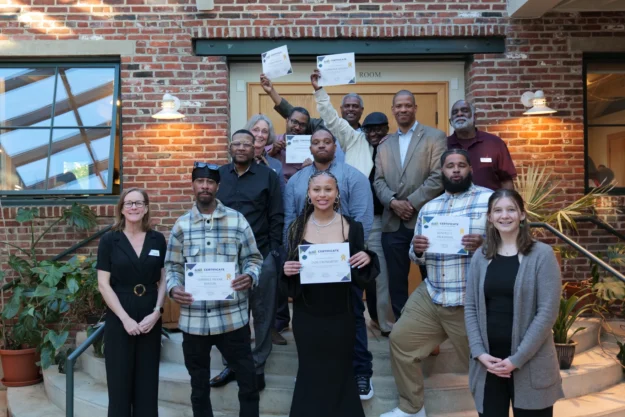
The 2024 graduation class of the Delaware Center for Horticulture’s Branches to Chances workforce reentry program.
Delaware Public Media recently did a feature on the Delaware Center for Horticulture’s ‘Branches to Chances’ program, which introduces the formerly incarcerated, homeless, or unemployed to horticulture while working towards job placement and building work-life skills. DPM’s Kyle McKinnon spoke with Branches to Chances Coordinators Robert Harris and Bonnie Swan to learn more about the Center’s reentry program and this year’s graduation class. Click here to listen to the interview.
Bonnie talks about the Delaware Center for Horticulture’s partnership with Jewish Family Services of Delaware (JFS) at the 3:40 mark of the interview. JFS partners with the Center to do two therapy groups a year with the members of Branches to Chances to help them with conflict resolution, discuss trauma and it’s impact, communication, and relationship styles. We then follow through with the cohort to do case management. In that role, we are working to help find housing, substance abuse treatment, eliminate risk factors, boost protective factors, and have an overarching goal of reducing recidivism and keeping the clients in the program.
Pam has been utilizing JFS counseling services for five years and feels that it is essential to her well-being.
Why did you begin counseling with JFS?
“I was involved in a relationship with an addict. We were engaged. And because I’ve never done drugs and am not familiar with it, it went on for years with me not realizing it. Because both my parents are alcoholics, I know what an enabler is. It was very difficult to navigate. I had my daughter living with me, my son was angry with me that I stayed in the relationship. Just keeping that person alive was very traumatic to me, and to my kids as well.”
What improvements have you seen since starting counseling?
“I sleep better at night. I’ve been working with Mike and he’s such a great counselor, very professional. As a mother I second-guess myself all the time, and I’m always looking to improve. I need Mike’s help to guide me. He’s never forceful in suggestions; he has resources that are helpful. At this point, he’s like talking to my best friend. So, it’s imperative for me to continue to grow in a positive direction.”
Would you recommend that others seek out counseling?
“Absolutely. Come into with an open mind. Everybody should check in with a professional once and a while. Most people second-guess themselves, and it’s nice to have a professional to help you navigate through trying times. When I was a teenager, something very traumatic happened to me, and I was required to go to counseling. My father saw it as a weakness and didn’t want to get involved. I was still at the age where I was challenging my parents on their beliefs. I wasn’t intending to hurt anyone; I just had to expand my growth and knew counseling was the only thing I could do to get help. So, I was raised that counseling was not good. I think a lot of people have the misconception about counseling that someone is going to tell you that you’re all wrong and this is how you have to do it better. I’ve never had that situation with counseling at JFS, which is validating and important. I’m a huge advocate for counseling.”
Start your therapy journey today by submitting an online intake form or contact our Intake Department at 302-478-9411 ext. 306
In 1899, a visionary group of Jewish leaders from Wilmington embarked on a journey to improve people’s lives in the community.
Originally named the Hebrew Charity Association, the organization’s early mission was clear: to alleviate the suffering of less fortunate members of our Jewish community; to assist them to become self-supporting; to act as a peace committee to adjust the differences among members of the Jewish community; and to perform all such duties as may come before us in the name of charity.
By November 1930, the Hebrew Charity Association was incorporated, comprising 17 signatories who met regularly in an office at the corner of Eighth and Orange Streets in Wilmington. Under the 23-year leadership of Morris Levy, the organization achieved great stability, touching lives through financial, legal, and medical aid.
By the 1960s, services had expanded dramatically, and the agency’s name was changed to Jewish Family Service of Delaware; in 2005 the agency again changed its name to Jewish Family Services of Delaware, emphasizing the multitude and variety of “kaleidoscopic” services provided.
Now in 2024, JFS Delaware is celebrating 125 years of dedicated service to the community. JFS has grown and evolved over the past 125 years. A century ago, our focus was the Jewish community. In modern times JFS serves not only the Jewish community, but any Delawareans who need our help. Our positive impact has multiplied.
“The more I’ve worked in the nonprofit sector, the more I see that the term “social impact” is a more appropriate way to describe what we do,” said JFS Delaware CEO Renna Van Oot. “When the community comes together, the board is visionary, strong, and united with a dedicated staff – worlds can be changed. JFS has maintained this for 125 years, and I couldn’t be more proud to be a part of this team and community.”
Today, JFS offers many diverse services and programs, providing comprehensive support to all, regardless of religion, race, socio-economic status, sexual orientation, gender identity, ability, or special need.
Our individual and family counseling services help children, teens, adults, and families develop strategies to cope with their unique challenges.
Our RISE (Refugee Integration Support Effort) program helps refugees and other immigrants from all over the world integrate and make a home in their new communities in Delaware.
The COMPASS program provides specialized medical care for older adults with dementia and—just as importantly—critical support for their caregivers including education, counseling, and improved access to services.
Through JFS’ Care Navigation services, older adults, adults with disabilities, and their loved ones can access compassionate, professional, and personalized care management services to enhance quality of life, encourage independence and healthy lifestyles, and ensure a safe and supportive living environment.
Cancer Care Connection, an affiliate of JFS Delaware, helps people affected by cancer navigate the full range of the issues they face, make informed decisions, and take action on their own behalf.
Promoting Safe and Stable Families (PSSF) strengthens and empowers families that are at-risk or in crisis by helping them to identify support systems and develop action plans to reach their goals with confidence.
JFS continues to evolve to this day. Yet, its core mission—inspired and guided by the Jewish values of our founders—has never changed: to provide counseling and support services which strengthen the well-being of the individual, family, and community.
To celebrate this special milestone of 125 years of service, JFS invites you to partner with us at our 125th Anniversary Celebration on Saturday, April 6 at the Deerfield Golf Club, Newark, DE where we will enjoy a night of fun and history. There will be cocktails, hors d’oeuvres, and silent and live auctions featuring the area’s finest restaurants and businesses, new vacation packages, unique entertainment offerings, original artwork, sporting events, and so much more.
We will also honor the late Gilbert J. Sloan, Ph. D. by renaming the JFS Care Navigation Program the Gilbert J. Sloan JFS Care Navigation Program. Dr. Sloan was a strong supporter of JFS for many years and a beneficiary of this program.
At the heart of the JFS 125th Anniversary Celebration, our purpose shines brightly: To celebrate a legacy of unwavering commitment to and compassion for our community. For generations, we have provided help to others when they needed it most. On April 6 we will celebrate what that history has shaped: a strong and vibrant JFS, providing essential support services and skilled counseling to all in need. We invite you to join us in celebrating JFS’ achievements and supporting its future!
Visit www.jfsdelaware.org/125th-anniversary/ to purchase tickets or become a sponsor of the JFS Delaware 125th Anniversary Celebration.
By Madison Warfel, JFS Delaware Marketing and Communications Specialist
CHILD, Inc. is a private, non-profit organization that offers prevention, treatment, emergency shelter and advocacy services that strengthen families. The organization serves dependent, neglected, and abused children and their parents. They provide programs for those involved in domestic violence situations, especially children.
Located in Wilmington, CHILD, Inc. has been helping the children and families of Delaware since 1963.
Anne Altemus, Program Director of the Domestic Violence Treatment Program, has been with CHILD Inc. for 35 years. “What I like about our Domestic Violence Treatment Program is that it treats the whole family,” said Altemus. “We have offender programs, we have victim or survivor programs, and of course we have programs for helping children heal. We are the only program in New Castle County that treats the whole family for intimate partner abuse or domestic violence.”
“Domestic violence is a very serious problem,” continued Anne. “With the contacts that we have with the other agencies that we work with; we’re hoping to prevent and end domestic violence in families.”
And that’s where Jewish Family Services of Delaware and their Mental Health Fellowship Program comes in. The federally funded Fellowship Program began in 2022 as a response to the rapidly increasing mental health demand throughout the Delaware community, as well as the shortage of Licensed Mental Health providers throughout the state. JFS provides Master Level Social Workers and Mental Health Counselors with support for two years while they participate in meaningful work and leadership development, and JFS helps prepare them to take and pass the LCSW or LPCMH test to be fully licensed.
The Fellowship Program has formed over a dozen partnerships with schools and nonprofits in the community. One of those partnerships is with CHILD, Inc.
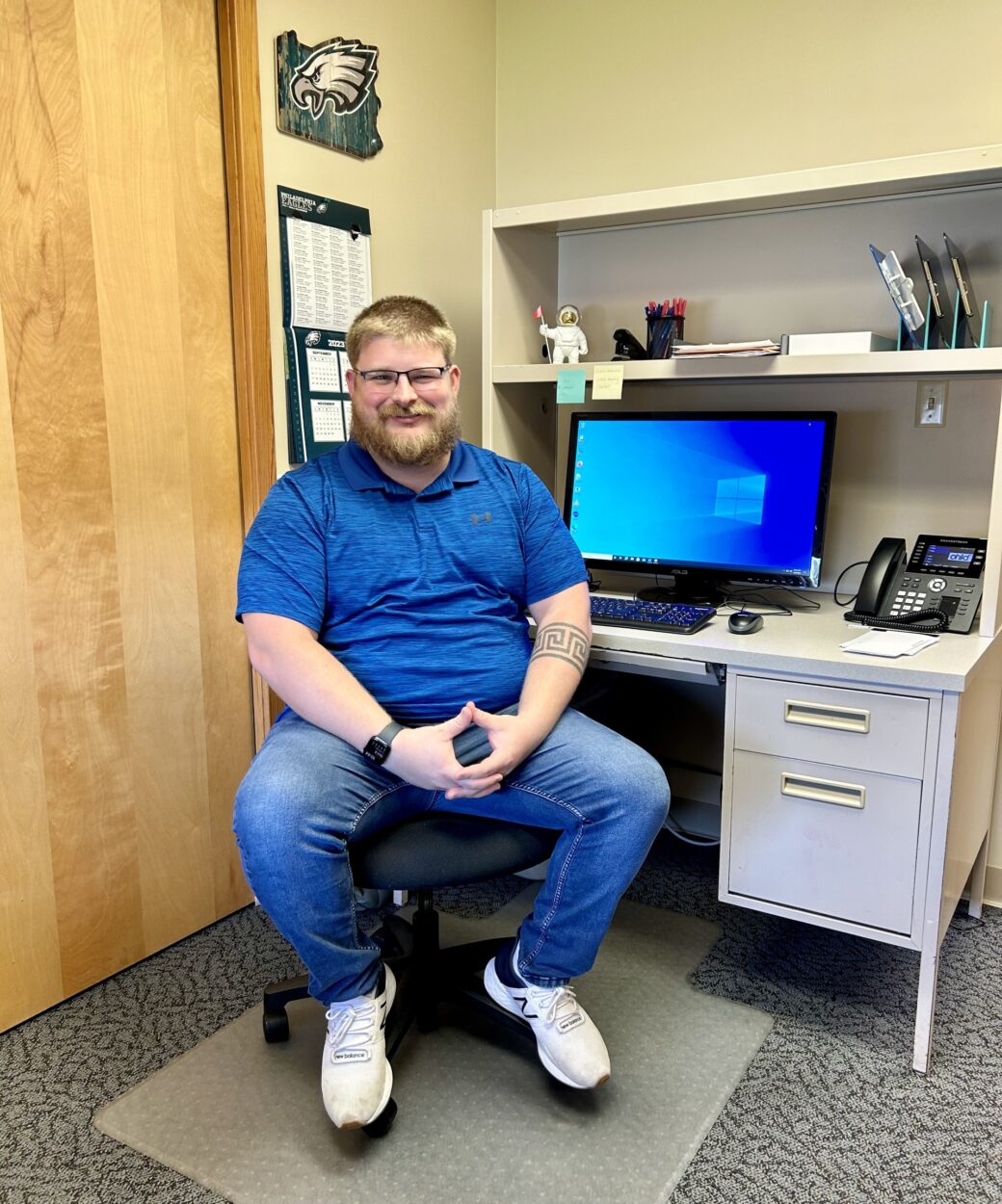
Zach King, JFS Fellow
“I actually started my career at CHILD, Inc.,” said Rebecca McAdams, Clinical Supervisor of the JFS Fellowship Program. “I started as a Community Based Counselor in shelters in the Sparrow Run area. I was working with children who had survived or were surviving domestic violence. I felt so privileged to start my career at CHILD, Inc., and that’s why we brought the Fellowship here.”
One aspect of the Domestic Violence Treatment Program is the Offender Intervention Services (OIS), which provides structured counseling interventions for both men and women who have committed acts of intimate partner violence or abuse. Participation in the intervention services can be either voluntary or court mandated.
“This field is not for everyone,” said Anne. “You must be able to work with an offender and someone who has been victimized or is a survivor. And not everyone can do that… What we focus on in the offender program is to accept responsibility for behavior while also treating them with respect so that they can understand what that means and apply it so that they can have a healthy relationship with their children, with their partner, or ex-partner.”
As the clinical supervisor of the JFS Fellowship Program, Rebecca helps the fellows find their niche or specialty within mental health counseling. One such fellow was Zach King. Rebecca reached out to Zach
about him potentially working with identified perpetrators at CHILD, Inc. Much to her surprise, Zach was all in. “That’s such a rare niche to have, and it also takes a lot of patience to do that,” said Rebecca.
Zach has been with CHILD. Inc. for several months now and has fully embraced the work, despite the challenges it provides. He also just recently passed his LPCMH licensure exam.
“We really had a need for someone who was interested in doing the work, who could actually do the work, and who had the skills to be able to do the work,” said Ann. “And the personality to fit in here. Zach was such a great match.”
Both Rebecca and Ann agree that agency partnerships play a crucial role in tackling the mental health demand and community issues in the state. The partnership between CHILD, Inc. and JFS Delaware is certainly a step in the right direction.
For more information about CHILD, Inc., visit www.childinc.com. Their main office can be reached at 302.762.8989, and the phone number for their 24-hour domestic violence hotline is 302.762.6110.